Travis County Leaders Approve Budget to Support the Travis County Transformation Project
Travis County, TX — Yesterday, Travis County District Attorney José Garza announced that the Travis County Commissioners Court approved $2 million in the Fiscal Year 2027 budget to continue the Travis County Transformation Project (TCTP), a pre-arrest restorative-justice diversion program for juveniles accused of family violence involving their caregivers. In August 2026, the Travis County District Attorney’s Office requested funding on behalf of the community partners implementing the program. On September 29, 2026, the Court approved funding to support our community partners in continuing the program for two years.
The Travis County Transformation Project aims to help break intergenerational cycles of violence in Travis County. It serves youth facing assault family violence charges, a population identified through 10 years of county prosecution data showing that this is the most frequent charge leading youth into juvenile detention. Data released by the Travis County Sheriff’s Office in 2019 showed that 38% of Travis County homicides arise from domestic violence incidents. By intervening early, the program seeks to help prevent violence from escalating into adult intimate partner relationships.
The program offers a pre-arrest, community-based alternative for 10- to 16-year-olds, allowing caregivers to choose a restorative path for their kids instead of juvenile detention. During the pilot years from June 2023 to June 2025, the program was limited to 15- and 16-year-olds. The eligible age range was expanded in 2025 to accept 13- and 14-year-olds and then expanded again in 2026 to reach kids sooner, since more than half of assault family violence offenses annually involve youth younger than 15.
Since the program launched, 150 kids have been deflected from the juvenile justice system. They first receive respite and a cooling-off period, then connect with individual counseling through LifeWorks. After a thorough intake process conducted by the community partners at the Excellence Project, families engage in a transformative program lasting eight months to a year, depending on each family’s needs, where they confront the root causes of violence, nurture familial bonds, and work to minimize child welfare interventions.
After completing the program, families have a fresh start, connected to much-needed resources and community support, free from further engagement with law enforcement and with no record in the juvenile justice system. They have received intensive case management and advocacy, trauma-informed counseling, psychological evaluations, restorative justice healing circles, and respite services. Together, these services give young people a chance to heal, build new skills, and move toward a brighter future, keeping our community safe.
Our esteemed partners made their success possible: LifeWorks, the Excellence Project, the Travis County Juvenile Probation Department, the Austin Police Department, the Travis County Sheriff’s Office, the Pflugerville Police Department, the Manor Police Department, and The University of Texas at Austin.
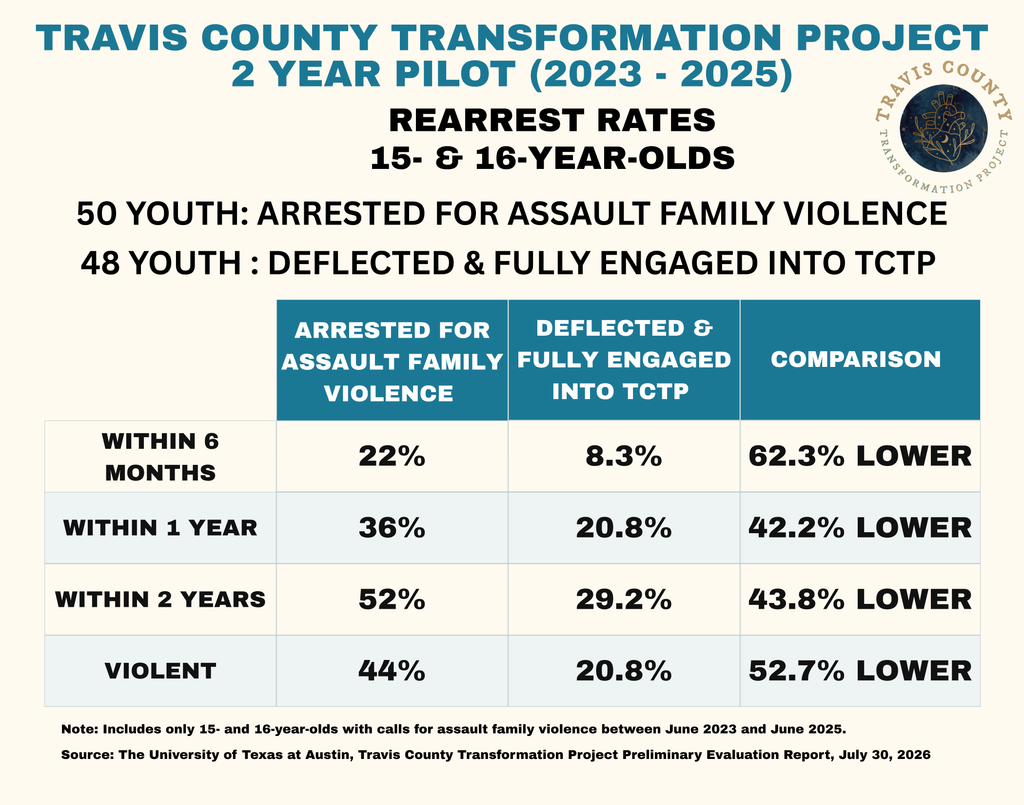
Researchers at the University of Texas at Austin evaluated the program throughout its two-year pilot, from June 2023 to June 2025. During that period, the project diverted 72 young people ages 15 and 16 from the juvenile legal system. Meanwhile, 50 young people of the same ages were arrested for assault family violence and proceeded through the traditional juvenile legal system at Garner Betts.
After the pilot ended, we continued tracking the young people’s recidivism, measured by rearrest rates, for the two years after they completed the program. Of the young people who went to Gardner Betts, 52% were rearrested during that period. By comparison, 29% of those who participated in the Travis County Transformation Project were rearrested.
Preliminary evidence suggests that rearrests were 62.3% lower after 6 months, 42.2% lower after a year, and 43.8% lower after 2 years among deflected youth with full engagement in the program, compared with youth who were not deflected and proceeded through the traditional juvenile legal system. Violent offense rearrests were 52.7% lower for deflected youth with full engagement than for non-deflected youth.
“Our two-year pilot program has shown that when we offer young people support and mentorship through community-based restorative practices instead of punishment, we can dramatically reduce recidivism and build a safer community,” said Travis County District Attorney José Garza. “We are grateful to our community and law enforcement partners, and to our county leaders, whose commitment is helping us reimagine justice for youth and create a brighter future for children in our community.”
###